Representation Theory
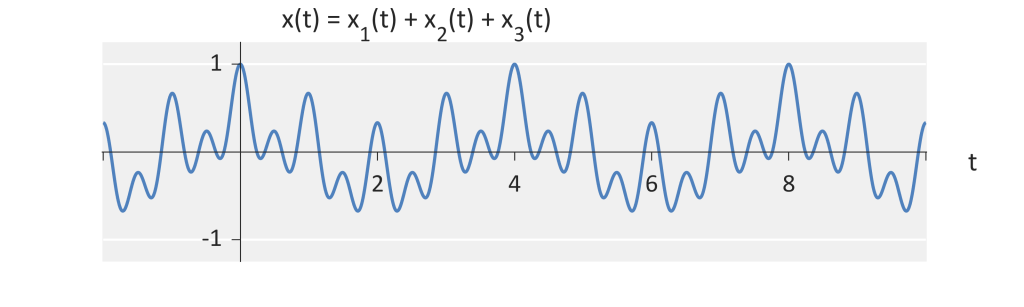
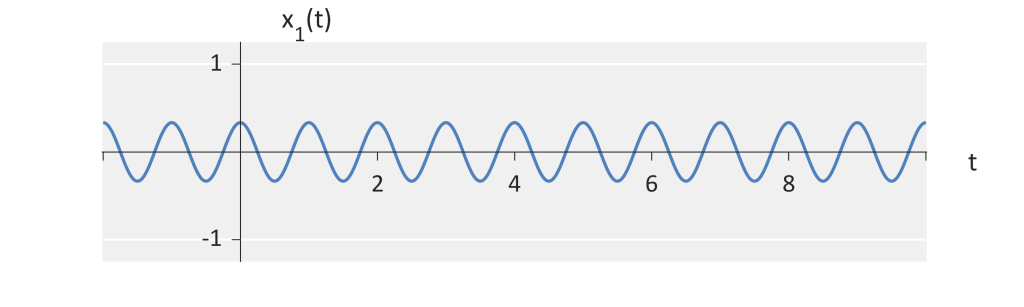
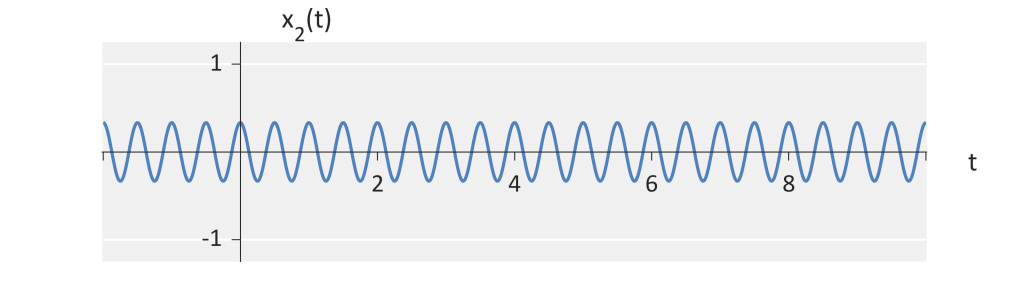
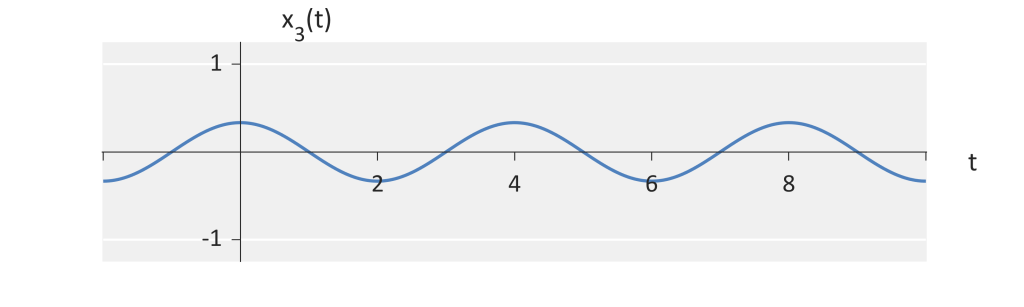
An important concept from signal processing is that we can often uniquely and completely represent a signal as a weighted sum (or weighted integral) of others signals. Mathematiclly, we can write this as

 denotes that we are summing over some signal collection (which could be finite or infinite in size). As an integral equation, this would be represented by

 or
 functions, then that collection of signals is known as a basis.
Frequency Representations
In the rest of this course, we will learn about four closely related frequency representations and their bases — (1) the frequency (Fourier) representation for continuous power signals, (2) the frequency (Fourier) representation for continuous energy signals, (3) the frequency (Fourier) representation for discrete energy signals, (4) the frequency (Fourier) representation for discrete power signals.
The Fourier Series
Continuous-Time Power Signals
For the Fourier series, we can express any continuous-time, power (periodic) signal as a summation of weighted complex exponentials (or equivalently, of weighted sines and cosines).
Fourier Series
We can express the Fourier Series in a compact manner with complex exponentials. In this case, continuous-time Fourier Series synthesis is defined by

Continuous-time Fourier Series analysis is defined by

 and
 is the fundamental period of the wave.
Existence and convergence
The Fourier Series of a continuous-time, periodic signal  is guaranteed to exist if
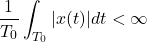
is a power signal, it will satisfy this property.
The Fourier Series converges to (i.e. it reconstructs perfectly) when three conditions are satisfied:


The Fourier Transform
Continuous-Time Energy Signals
For the Fourier Transform, we can express any continuous-time, energy (aperiodic) signal as a continuous summation (i.e., an integral) of weighted complex exponentials (or equivalently, of weighted sines and cosines).
Continuous-time Fourier Transform
Continuous-time Fourier transform analysis (i.e., the Fourier transform), is
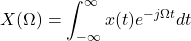
Continuous-time Fourier transform synthesis (i.e., the inverse Fourier transform) is

Note that the constant (i.e., the normalization) in front of the Fourier transform and inverse Fourier transform may sometimes differ depending on your field of study.
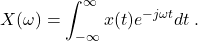
Fourier Transform Derivation
Consider Fourier series analysis:
An aperiodic signal is a periodic signal with a fundamental period that approaches
 . In this condition, we get

As  , then
 . Since
 is a variable that spans from
 to , then we can say product
 becomes a continuous variable. Therefore, our equation becomes
Existence
The Fourier Transform of a continuous-time, aperiodic signal is guaranteed to exist if

is a energy signal, it will satisfy this property.
Caveat: Some periodic signals (e.g., sines and cosines) can have a Fourier transform through the Fourier Transform’s connection to the Fourier Series and through the use of the Dirac delta function, even though periodic signals fail to satify the above property.